
Winkler County Court Records After Jail Arrest
A Winkler County arrest can begin with the sheriff, Kermit Police Department, Wink Police Department, Texas DPS, or another agency working in the county. The person is booked at the Winkler County Detention Center, where the jail creates a custody record and may list a booking-stage charge label. That jail label is useful, but it is not the final court record. Texas law then requires an arrested person to be taken before a magistrate without unnecessary delay for the Article 15.17 magistrate warning, where rights, counsel, probable cause, and bail issues may be addressed.
The court record forms after prosecutor review. Felony charges in Winkler County run through District Attorney Amanda Navarette, and felony case records are normally maintained by District Clerk Geneva Baker. Misdemeanor matters may involve county-level prosecution and a different clerk record, depending on the offense and court. The county jail record and the court record answer different questions: custody records show whether someone was booked or held, while court records show filed charges, court dates, plea, judgment, dismissal, or sentence. For the custody side of the same arrest, use the local jail inmate records path; for booking photos, use the Winkler County jail mugshots page.
Winkler County Arrest to Court Record Path
The practical path is short, but each step is kept by a different office. Current custody status starts with the sheriff's office and the sheriff-linked VINELink custody search. Bond information may first appear at the jail or magistrate stage. The filed charge, however, belongs in the clerk-maintained case record after a complaint, information, or indictment is filed. That is why a booking charge may not match the final court charge. Prosecutors can reject a case, amend a count, reduce a level, enhance a charge, add a new count, or present a felony to a grand jury.
- Confirm the arrest and current custody through the sheriff/VINELink path or the detention center phone line.
- Identify whether the charge appears to be a felony, misdemeanor, warrant case, or another-agency hold.
- Check the District Clerk for felony district-court records and court dates after prosecutor filing.
- Use county-level clerk channels only where the case type fits, since the County Clerk says that office does not handle felony cases.
- Compare the filed charge to the jail booking charge before treating either entry as the final case result.
The image below comes from the official Winkler County District Clerk page, the local source that links court researchers to statewide Texas case information.
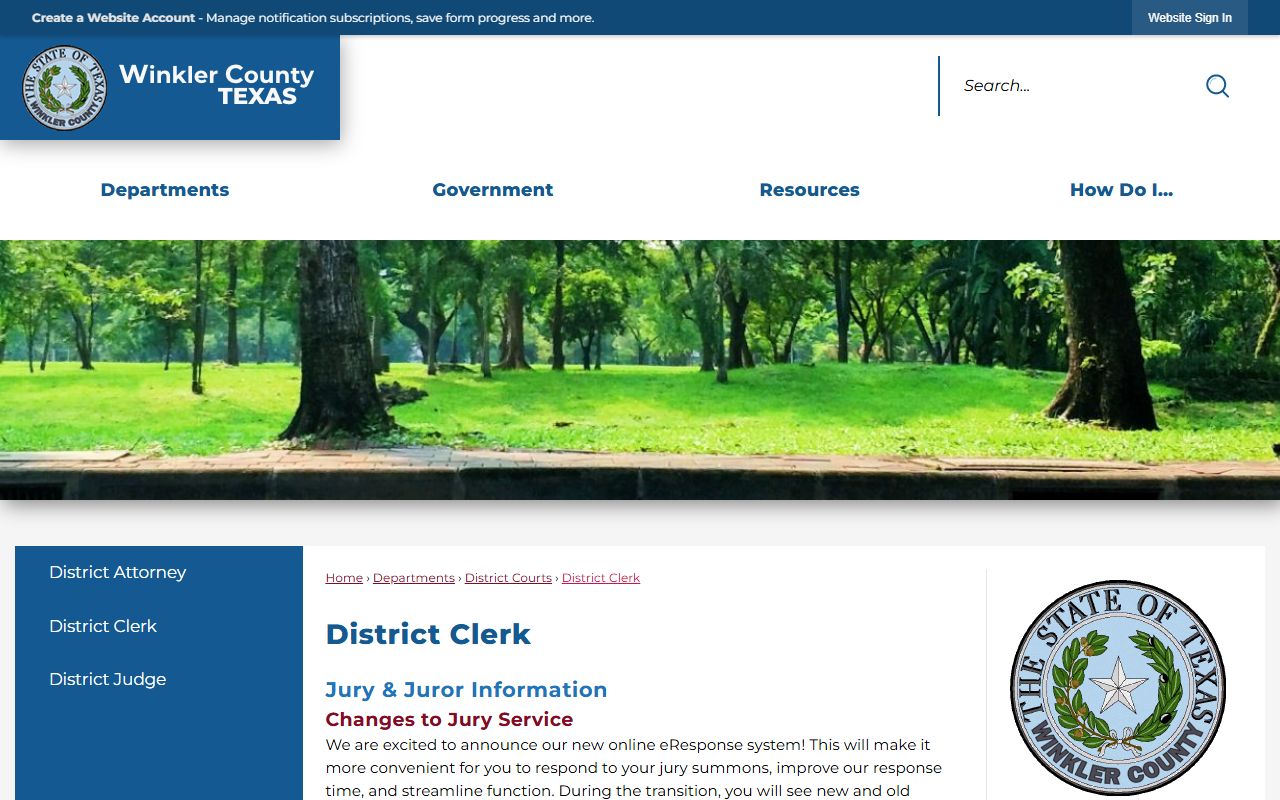
That clerk page matters because it points users beyond jail booking records and toward the court file that tracks filed charges after a Winkler County arrest.
Winkler County Court Records Access Channels
Winkler County has more than one public-record channel, and each one has limits. The District Clerk page links Texas Courts Research for attorneys and paralegals searching case information from all Texas counties. The County Clerk page links a Tyler-hosted Winkler County records portal, but that portal is not a jail roster and should not be treated as a complete criminal case search for every arrest. The County Clerk page also states that the office is not required to perform searches, except for federal tax lien search, and that people must come to the office to search records not on the website.
For felony charges after a Winkler County arrest, the local prosecutor contact is District Attorney Amanda Navarette at the Winkler County Courthouse, 100 East Winkler Street, Kermit, with mail to P.O. Box 1041 and phone 432-586-3700. District Clerk Geneva Baker is the clerk contact for district-court records at the same courthouse on the 3rd Floor, with mail to P.O. Box 1065, phone 432-586-3359, and posted hours of Monday through Thursday, 8 am to 5:30 pm, plus Friday, 8 am to noon. Those office roles are separate from jail custody status, which remains with the sheriff and detention center.
| Channel | Best Use | Limits | Search Detail |
|---|---|---|---|
| District Clerk | Felony district-court case records, filed charges, court dates | Not a jail roster or mugshot source | Name or case number when available |
| Texas Courts Research | Statewide court research linked by the District Clerk | Access may vary by user role or query | User/search access through the portal |
| County Clerk / Tyler portal | County-level records where applicable | County Clerk says felony cases and traffic tickets are not handled there | Disclaimer acceptance before portal search |
| Sheriff / VINELink | Current custody, release status, booking-stage labels | Does not replace the filed court record | Person name, state, agency filters when exposed |
| DPS conviction search | State conviction-history research | Not a live jail roster and not proof of every arrest | Name-based conviction lookup through DPS terms |
The Texas Courts Research portal is pictured below as a statewide court-record tool linked from Winkler County's own District Clerk resources.
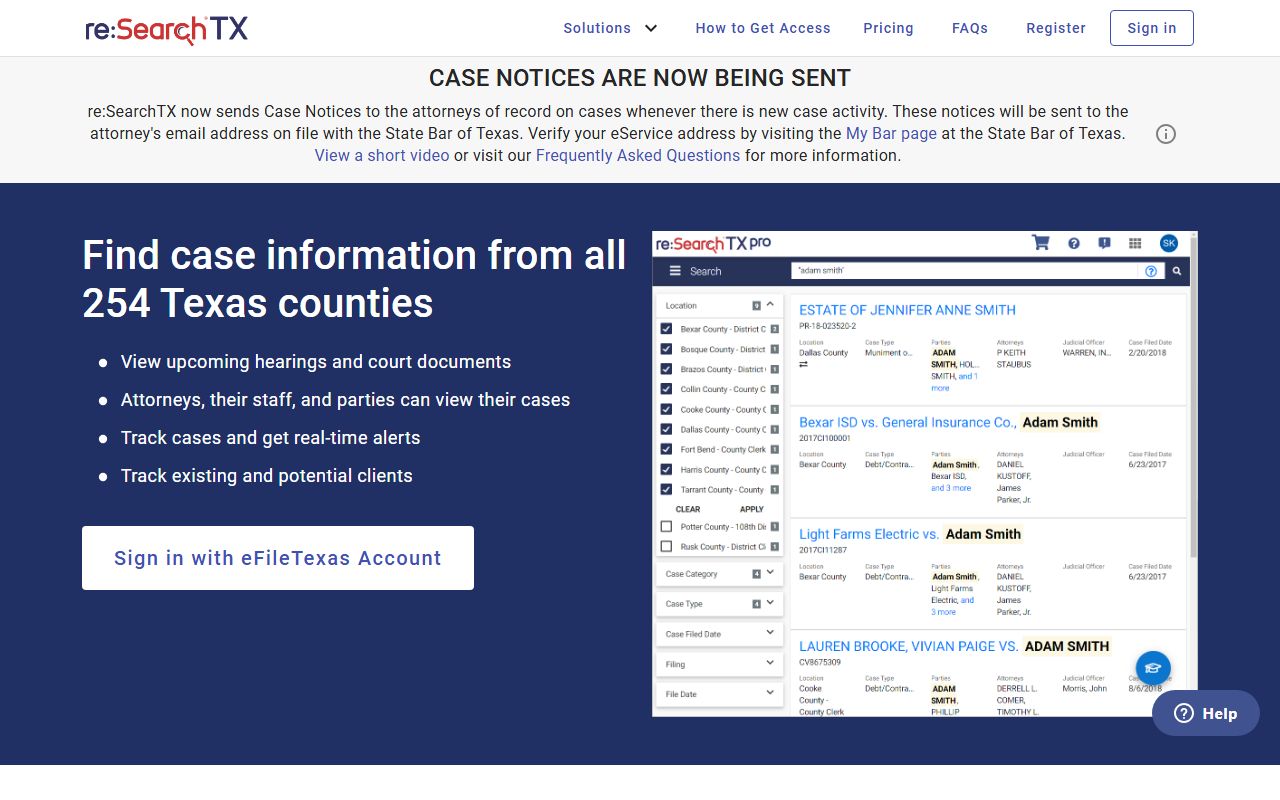
Use statewide court research for filed case information, then return to the local clerk or sheriff when a record requires a county office, a file copy, or a public-information request.
Winkler County Charging Documents After Arrest
The document that starts or advances a criminal case is not always the same document that caused the booking. An arrest warrant, officer statement, or intake entry may explain why a person was taken to jail. A complaint, information, or indictment is the court-facing charge document. In Winkler County court records after a jail arrest, that distinction helps explain why a jail entry may say one thing while the later case file lists a different offense level, statute, count, or cause number.
| Document | Who Uses It | Where It Fits | What to Check |
|---|---|---|---|
| Complaint | Officer or prosecutor | Can support an initial charge or early case filing | Named defendant, alleged offense, date, probable-cause facts |
| Information | Prosecutor | Common charging document for many misdemeanor cases and some procedural stages | Filed charge, offense level, prosecutor signature, cause number |
| Indictment | Grand jury | Common formal step for serious felony cases | Grand-jury filing, count list, enhancements, district-court cause number |
Felony matters should be tracked through the District Clerk after filing, while County Clerk channels must be used with care because the local County Clerk says that office does not handle felony cases. A person can be arrested, booked, warned by a magistrate, and released on bond before the clerk file shows all later prosecutor actions.
Winkler County Charge Status Records
Charge status tells whether an accusation is still moving through court. It also tells why a search result should not be read too fast. A pending charge is not a conviction. A dismissed charge is not the same as an expunged record. An amended charge may carry a different level or statute than the jail booking label. These changes are normal parts of prosecutor review and court processing after a Winkler County arrest.
| Status | Plain Meaning | Record Caution |
|---|---|---|
| Pending | The charge has been filed or is awaiting court action. | Check future settings and bond conditions before assuming outcome. |
| Amended | The prosecutor or court record changed the charge language, count, or level. | Compare the current filing to the original booking label. |
| Reduced | The case moved to a lower offense level or lesser charge. | The old charge may still appear in older jail or docket history. |
| Rejected or not filed | The prosecutor did not move forward on that accusation. | Booking records may still exist unless later restricted by law. |
| Dismissed | The court case or charge was ended without conviction on that count. | Dismissal alone does not always remove public records. |
| Convicted | A plea or verdict resulted in guilt on the charge. | Later custody may move to TDCJ, county sentence, probation, or another status. |
Statewide criminal-history tools have a narrower role. The Texas DPS Crime Records division and public conviction-name search can help with conviction-history research, but those systems are not live jail custody tools and do not replace a Winkler County clerk case file.
Bond and Warrants After Winkler County Arrest
Bond is usually addressed near the front of the case path. Under Texas Code of Criminal Procedure Article 17.15, bail should give reasonable assurance that the person will appear, should not be used as oppression, and should account for the offense, ability to make bail, and safety concerns. Winkler County did not publish a bond window, payment method, or local bond schedule in the official sources reviewed, so the practical step is to call the detention center or sheriff before trying to post cash, surety, property, or personal bond.
- Cash bond
- Money paid as security for appearance, subject to court handling after the case.
- Surety bond
- A licensed Texas bail bond company posts bond for a fee or collateral.
- PR bond
- A personal bond, or own-recognizance release, based on a promise to appear and any court conditions.
- No-bond hold
- Custody status where ordinary release is blocked until a court action or outside hold is resolved.
- Detainer
- A hold request from another agency, such as another county, parole authority, federal agency, or immigration authority.
No official Winkler County active warrant search was located on the county website. The sheriff page does not publish a warrant list, and the District Clerk and County Clerk pages do not provide a public warrant portal. A warrant arrest can still create both a jail record and a court record. The issuing court, charge, bond amount if set, pickup instructions, and hold status may control whether the person can bond out from the Winkler County Detention Center.
Warrant questions should be routed to the issuing office, not to an unofficial web result. The sheriff's office can be called for local warrant or custody routing. The District Clerk can help with district-court bench warrant or felony case status. Justice of the Peace records may involve Precinct 1 and 4 at the courthouse or Precinct 2 and 3 in Wink. Municipal warrants must be checked with the relevant city court or police agency.
Winkler County Arrest Charge vs Conviction
A charge is an accusation. A conviction is a court result. That basic rule is critical when reading court records after a jail arrest in Winkler County. The jail booking record may show why a person entered custody, the prosecutor's filing may show the formal accusation, and the judgment or docket outcome may show whether the person was convicted, acquitted, dismissed, placed on deferred adjudication, sentenced, or released from that count.
| Point of Comparison | Charge | Conviction |
|---|---|---|
| Meaning | An allegation filed or listed after arrest. | A final guilty finding or plea outcome. |
| Timing | Appears before case outcome. | Appears after plea, verdict, or judgment. |
| Best source | Clerk case file and prosecutor filing. | Judgment, disposition, DPS conviction history, or TDCJ record if sentenced. |
| Risk of misread | Can be changed, dropped, or reduced. | Can still have appeal, sentence, probation, or later relief issues. |
When a person is sentenced to state prison or state jail, the lookup path may shift from the county court file to the Texas Department of Criminal Justice. TDCJ records show sentenced custody, not every local arrest. Federal sentenced prisoners use the BOP locator, and immigration custody uses ICE ODLS. Those systems answer custody questions that the Winkler County court file may not answer after transfer.
Sealed or Expunged Court Records After Arrest
Public access can change after a case ends. Texas Government Code Chapter 552 controls many public-information requests, and the Texas Public Information Act allows access unless an exception or confidentiality law applies. For law-enforcement records, Government Code Section 552.108(c) is important because basic information about an arrested person, an arrest, or a crime is not excepted even when some law-enforcement material may be withheld. That rule does not mean every document, photo, or identifier must be released.
| Point of Comparison | Sealed / Nondisclosed | Expunged |
|---|---|---|
| Basic effect | Public access is restricted, but some agencies may retain limited access. | Eligible arrest records are removed or treated as not available under the order. |
| Texas source | Depends on the nondisclosure or sealing law and order. | Texas Code of Criminal Procedure Chapter 55. |
| Typical trigger | Eligible disposition and court order. | Eligible acquittal, pardon, dismissal, no-charge event, or other statutory ground. |
| Public search result | May be hidden from public view. | Should not be treated as a public arrest record once the order applies. |
Juvenile records, protected victim data, active-investigation material, sealed cases, expunction orders, and certain personal identifiers may limit what the sheriff or clerk releases. A dismissed charge may still have a public record unless a separate order restricts access. For written booking records, arrest reports, or booking photos not online, the public-information path runs through the sheriff's office and the Texas Attorney General's public-information request guidance.
Important: Do not use a casual court or arrest lookup for employment, tenant, credit, insurance, or other FCRA-covered screening.